Fly Pelican, Fly
🔥 Got it. Here's your breakdown for The Berkshire Eagle – October 6, 1976, ready to drop into the next blog post when you're back from the Budtender's Ball:
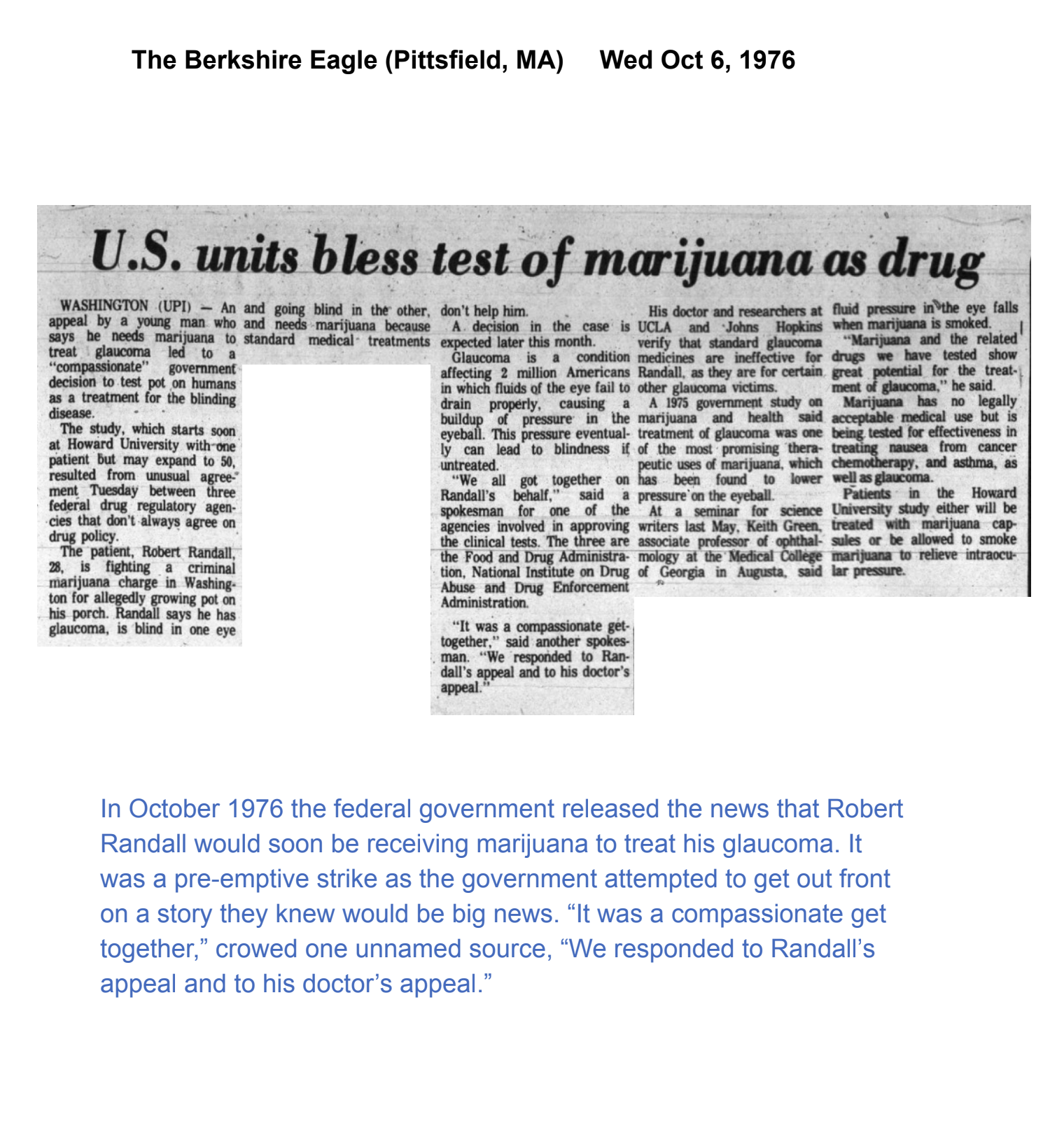
The Berkshire Eagle (Pittsfield, MA) – Wed Oct 6, 1976
Title: “U.S. units bless test of marijuana as drug”
📰 Composition & Headlines
This article marks a pivotal shift in the media narrative—from advocacy coverage to government endorsement. The headline is bold and disarming: “U.S. units bless test of marijuana as drug.” The passive yet positive phrasing (“bless test”) signals public legitimacy and federal approval, hinting that cannabis was entering mainstream medical dialogue. The tone is notably less combative than earlier stories, reflecting a shift in federal posture.
🧠 Content & Significance
The article reveals that Robert Randall’s appeals—backed by his physician—successfully pushed the federal government to permit the medical use of marijuana under experimental circumstances. This moment would quietly become the foundation of the Compassionate Investigational New Drug (IND) Program.
Key details:
Randall is named as the first patient in a federally sanctioned marijuana research trial.
The trial, based at Howard University, was greenlit by three federal agencies:
Food and Drug Administration (FDA)
National Institute on Drug Abuse (NIDA)
Drug Enforcement Administration (DEA)
It was framed as a “compassionate get-together”, likely to diffuse criticism.
The piece explains the scientific rationale: marijuana could lower intraocular pressure in glaucoma patients when standard medications failed.
🧩 Impact & Strategy
This story is more than a news article—it’s damage control and public relations rolled into one. The government preemptively leaked the story, knowing Randall’s case would soon explode in the courts and press. By controlling the narrative, they sought to present the move not as a capitulation, but as benevolence driven by medical necessity.
A key quote stands out:
“We all got together on Randall’s behalf,” said a government spokesman.
“We responded to Randall’s appeal and to his doctor’s appeal.”
This frames the move as humanitarian, not political, allowing the federal government to protect its institutional credibility while conceding to precedent-setting patient access.
Here’s my read on what’s happening under the surface:
Narrative Shift – Earlier press framed Randall as fighting against government intransigence. Here, the government reframes itself as a partner (“we all got together on Randall’s behalf”), softening its image before the legal precedent hardens.
Headline Engineering – “Bless test” is careful language. “Bless” is warm, even ecclesiastical, and “test” implies controlled caution rather than open endorsement. Together, it reassures the public this is not legalization, just benevolent science.
Bureaucratic Triangulation – Invoking FDA, NIDA, and DEA in one breath conveys legitimacy from every corner of federal authority — science, public health, and law enforcement — which helps neutralize critics on all sides.
Damage Control in Advance – By leaking the agreement through The Berkshire Eagle rather than a more adversarial national outlet, they controlled tone and audience, positioning the move as charity before Randall’s court case could paint it as a forced concession.
Subtext – The “compassionate get-together” line is almost quaint, a deliberate choice to de-escalate the culture-war temperature around marijuana in 1976. It lets the agencies say, we didn’t lose — we cared.